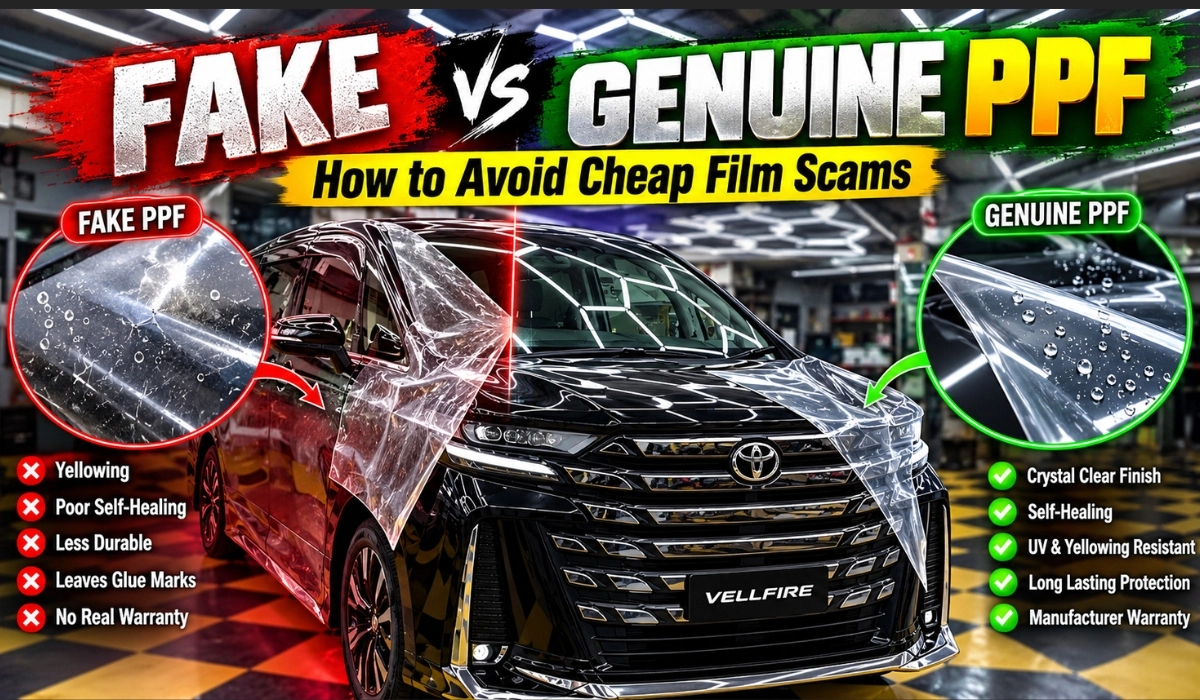
Fake vs Genuine PPF: How to Avoid Cheap Film Scams
✏ A D Nath | 🔖 Car Care
There is a popular saying in Hindi: Har chamakti cheez sona nahi hoti. Not everything that shines is gold. Imagine buying gold jewellery. You would not judge its purity simply by its shine or appearance. You would check its hallmark, purity, invoice, and the credibility of the jeweller. Gold is available in different purities, such as 18K, 22K and 24K, and each has a different composition and purpose.
The same principle applies to the automobile detailing industry, particularly when buying Paint Protection Film (PPF). PPF has become a popular choice among car owners who want to protect their vehicle's paint from stone chips, road debris and everyday wear. As demand has grown, customers have also encountered more brands, product options, prices and claims about film quality.
The problem is that two films may look almost identical after installation, even though their materials, specifications, durability and warranty terms may differ. The appearance of a film alone does not prove its quality or authenticity. Before spending your hard-earned money on PPF, you need to understand what you are buying, who is supplying it and what protection you can realistically expect.
1. Branded vs Non-Branded PPF: What Is the Difference?
For a customer's initial understanding, PPF products can broadly be divided into branded and non-branded options. However, this is a simplified distinction. A lesser-known brand is not automatically fake or poor-quality, just as a familiar brand name alone does not guarantee that a product is genuine.
Branded PPF
Branded PPF is sold under an identifiable brand with defined product specifications. Depending on the brand, customers may also have access to authorised installers, official warranty terms, product documentation and verification processes.
Before buying, check the exact brand and film series. Do not rely only on a logo displayed at the studio or a seller's verbal assurance. Ask whether the installer is authorised to sell and install that particular product. Also, confirm the warranty terms and whether the product can be registered or verified through the brand's official channels.
Non-branded PPF
Non-branded PPF can include generic films, products sold under lesser-known labels and films whose manufacturer or specifications are not clearly disclosed. Some lesser-known products may offer reasonable value. The important question is whether the seller can provide reliable information about the film's material, specifications, performance, warranty and origin.
The risk increases when a seller makes claims such as the same as a premium brand, imported branded material or the same quality at half the price without supporting evidence. A low price does not automatically mean that a film is fake. Equally, a glossy finish or premium-looking packaging does not prove that it is genuine.
2. The Risk of Lookalike, Misrepresented and Unverified Products
In a competitive market, customers may encounter products that resemble established brands or are marketed using impressive claims about their origin, technology and performance.
It is important to understand the difference between several situations:
- Lookalike products: Products whose branding or packaging may resemble those of an established brand.
- Misrepresented products: Films sold with claims about material, origin, thickness or performance that cannot be substantiated.
- Unverified products: Films for which the seller cannot provide clear information about the manufacturer, specifications or warranty.
- Defective or off-specification stock: Products that may have quality issues and whose actual condition needs to be established.
These categories are not interchangeable. A generic product is not automatically counterfeit. Similarly, claims that a film is rejected stock, B-grade material or a first-copy product should not be treated as fact without supporting evidence.
However, customers should be cautious when the product being supplied does not match the seller's claims. The important question is not simply whether the film looks good. It is whether the seller can demonstrate what the product actually is.
3. Why Do Customers Fall for Cheap PPF Offers?
One reason is a lack of product knowledge. A customer may know that PPF protects car paint but may not understand the differences between film materials, thickness, product specifications, warranties and installation methods.
Another reason is the desire to get a premium product at a much lower price. Suppose a customer receives a quotation for a particular branded PPF from an authorised installer. Another seller offers a film at a substantially lower price and claims that it is exactly the same product.
Naturally, the customer wants to save money. But before accepting the offer, it is worth asking an important question: If both products are genuinely the same, why is there such a large difference in price?
There may be legitimate reasons for different quotations, including the film variant, vehicle size, coverage, installation process, operating costs and warranty arrangements. A price difference alone does not prove that an offer is fake or misleading.
The right approach is to verify the product and compare the complete service rather than making a decision based only on the discount. Customers should not be blamed for being misled. Sellers are responsible for representing their products accurately. At the same time, buyers can reduce their risk by asking the right questions and checking the details before paying.
4. Is Branded PPF Only for Luxury Car Owners?
Branded PPF is often associated with premium and luxury cars because some owners are willing to spend more on protecting their vehicles. However, branded PPF is not exclusively for wealthy customers. The decision depends on the car, the owner's budget, driving conditions, expected ownership period and willingness to pay for paint protection.
There is nothing wrong with wanting premium protection for an affordable car. The problem begins when a customer assumes that a low-priced product must deliver all the benefits of a much more expensive product without checking its specifications.
If a genuine branded PPF is outside your budget, you have other options. You can compare different genuine products, consider partial PPF coverage or postpone installation until you can make a more informed decision. You do not have to install PPF simply because it is trending or because other car owners have installed it.
Buy the protection that suits your needs and budget, rather than stretching your budget for a product whose identity you cannot verify.
5. Can You Get Genuine PPF at Half the Price?
Sometimes a lower quotation is completely legitimate. A seller might be offering a different product variant, a smaller coverage package or a promotional price. However, if someone claims to offer the exact same branded film, with the same specifications, coverage, and warranty, at a dramatically lower price, ask for evidence before proceeding.
Consider a simple example.
Suppose one installer quotes ₹80,000 for a particular PPF package, while another quotes ₹40,000. You should not immediately conclude that the second installer is selling fake material. Nor should you assume that the first installer is overcharging.
Instead, compare the complete offering.
- Is the brand and exact product series the same?
- Is the film's material and specification documented?
- Is the coverage identical?
- Is the quoted price inclusive of GST?
- Is the installer authorised?
- Is the warranty genuine and applicable to your installation?
- Are maintenance and after-sales support included?
- Can the seller provide an invoice identifying the product?
If the answers are unclear, do not rush into making a payment. A genuine discount should still come with a clear explanation of what you are purchasing.
6. Bargaining Does Not Guarantee a Better Deal
Many customers take pride in negotiating a large discount. Negotiation itself is not a problem. The problem is assuming that getting a seller to reduce the quotation automatically means you have secured the same product for less money. Imagine a product for which one seller quotes ₹100 and another offers it for ₹60. The lower price does not establish that both sellers are supplying the same product.
The second seller may have lower operating costs, a different product, a different profit margin or a different service offering. You need to understand the reason for the difference. The same principle applies to PPF. If your main objective is to reduce the price, make sure you are not unknowingly compromising on the product, coverage or installation service.
A seller can reduce the price by changing the product or the work included in the package. That is why the final quotation should clearly identify what you are paying for. Negotiate the price, but do not negotiate away the information you need to make an informed decision.
7. How to Identify Genuine PPF Before Installation
You cannot always identify genuine PPF by looking at the installed film. Instead, verify the product and the seller before the installation begins.
Check the authorised dealer
- Confirm the installer's authorisation through the brand's official website or customer support, where such a facility is available. Do not rely entirely on a logo displayed at the studio.
Confirm the exact product and specifications
- Ask for the brand, product series, film material and technical specifications in writing.
- PPF thickness is one specification worth checking, but thickness alone does not establish overall quality. Material composition, optical clarity, durability, adhesive performance and other product characteristics also matter.
- If a seller claims that a film is TPU, ask for product documentation supporting that claim. Do not assume that every transparent paint protection film has the same material composition or performance.
Verify the warranty
- Ask who provides the warranty: the manufacturer, brand owner, distributor or installer.
- Check the warranty duration, coverage, exclusions and registration process. A warranty document by itself does not prove authenticity. Use the brand's official verification system where available.
Ask for a proper invoice
- The invoice should identify the product and describe the work being performed. Keep the quotation, invoice, warranty documents and installation details for future reference.
Confirm the coverage
- Ask whether the quotation covers the entire vehicle or selected panels. Confirm how the bumpers, mirrors, door edges and other areas will be treated.
- Two installers may quote different prices simply because their coverage packages are different.
Inspect the installation process
- Even genuine film can produce poor results if it is installed incorrectly.
- Check the installer's experience, cleanliness of the workspace, finishing around edges and approach to difficult panels. Ask how the studio handles installation defects and after-sales concerns.
Compare the complete package
- Compare the film, coverage, installation, warranty and after-sales service together. Do not compare two quotations using price alone.
8. A Real-World Example: What Should You Verify?
Consider a situation where a car owner wants PPF installed on a new vehicle.
The owner receives two quotations. One installer offers a clearly identified branded film, provides product documentation and explains the warranty. The other offers a much lower price and says that the film is exactly the same but cannot identify the product series or explain how its warranty can be verified.
The lower quotation may look attractive. However, the customer does not yet have enough information to establish that both offers are equivalent. The sensible next step is to ask for the missing details and compare the products properly. If the seller cannot provide reasonable answers, the customer can consider another installer.
This is an illustrative example, not a claim about a particular seller. It shows why product verification matters more than the size of the discount.
If you have personally encountered a similar case, add your actual experience here. Explain what was offered, what documents were available and how the product was checked. A genuine example will make this article more useful than a general warning alone.
9. What If Genuine PPF Is Outside Your Budget?
My suggestion is simple: do not feel pressured to buy a premium product just because it is popular.
First, consider how you use your car and what you want to protect it from. If full-body PPF is too expensive, ask whether partial PPF coverage would meet your needs. You can also compare other paint-care options, keeping in mind that they do not provide the same type of protection as PPF.
For example, ceramic coating can help with surface protection and maintenance, but it should not be treated as an equivalent replacement for PPF against stone chips.
If you decide to purchase PPF later, take time to research the available options and verify the product before paying. A cheaper product is not necessarily a bad product. But a product that cannot be verified should not automatically be treated as equivalent to a genuine branded product merely because it looks similar.
Read More:
Conclusion: Buy What You Can Verify, Not Just What You Can Bargain For
The saying not everything that shines is gold applies to PPF just as it applies to jewellery. A film may look glossy, the packaging may appear convincing, and the seller may make attractive promises. None of these things, on their own, proves the product's identity or quality.
At the same time, a higher price or a famous brand name should not remove the need to check the details. Before installing PPF, verify the brand, exact product, material specifications, dealer authorisation, warranty, coverage and installation process. If the seller cannot provide clear answers, take a step back and compare other options.
The aim is not to buy the most expensive PPF or the cheapest PPF. It is to understand what you are paying for and make a decision based on evidence rather than appearances or pressure. A good deal is not simply the lowest price. It is a product and service whose identity, quality, and terms you can verify.
