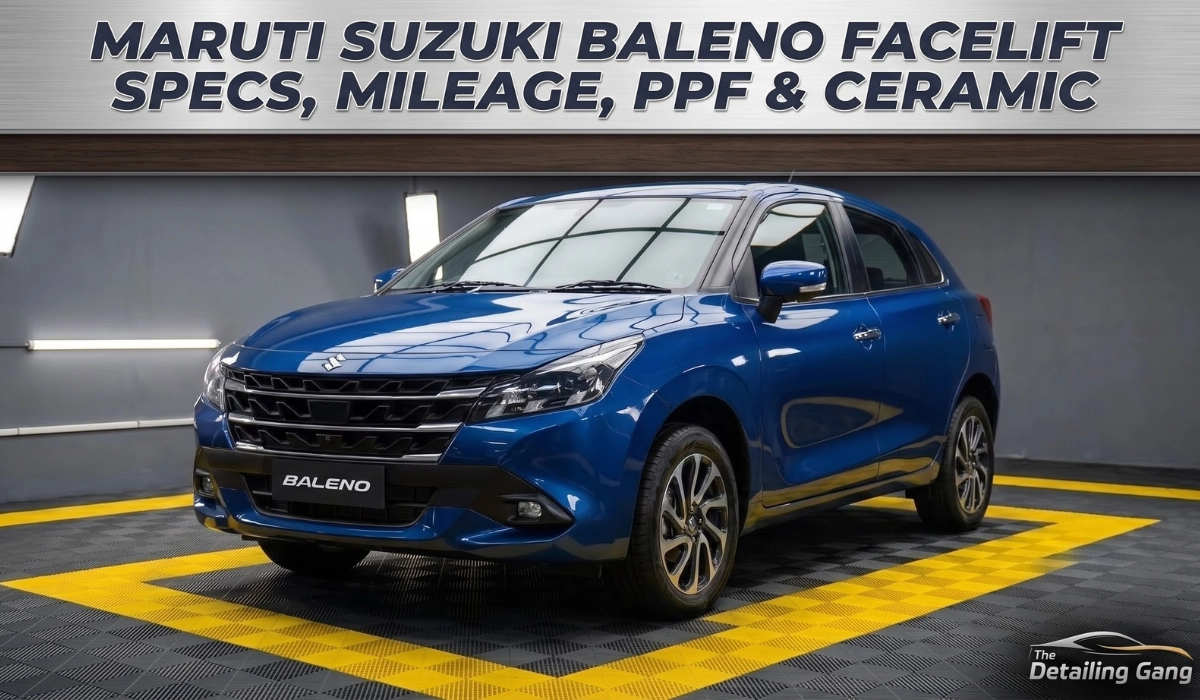
Maruti Suzuki Baleno Facelift Specs, Mileage, PPF, Ceramic
✏ A D Nath | 🔖 Car Detailing
The Maruti Suzuki Baleno has been one of the most popular premium hatchbacks for Indian car buyers, thanks to its practical size, spacious cabin, efficient engine, and easy ownership. The 2026 facelift continues that formula but adds important updates to the design, engine, technology, and safety package.
The Maruti Suzuki Baleno facelift gets a new 1.2-litre three-cylinder petrol engine, updated styling, ventilated front seats and a Level 2 ADAS safety system. It continues to offer a five-seat cabin and Front Wheel Drive layout, making it suitable for everyday city driving as well as highway trips.
For new owners, however, buying the car is only the beginning. Regular maintenance, careful washing, and proper paint protection can make a significant difference to how the Baleno looks after several years.
In this guide, we cover the Maruti Baleno specs, engine, mileage, dimensions, features, safety equipment, and the difference between PPF and ceramic coating for Baleno owners.
Maruti Suzuki Baleno 2026 Overview
The 2026 Baleno facelift is more of an evolutionary update than a completely new generation. Maruti Suzuki has concentrated on improving the areas that matter to everyday buyers while retaining the familiar Baleno shape and cabin layout. The front end receives the most visible changes. The car gets updated headlights and DRLs, a larger grille, a revised bumper, and a repositioned Suzuki badge. The alloy wheel design has also been slightly revised.
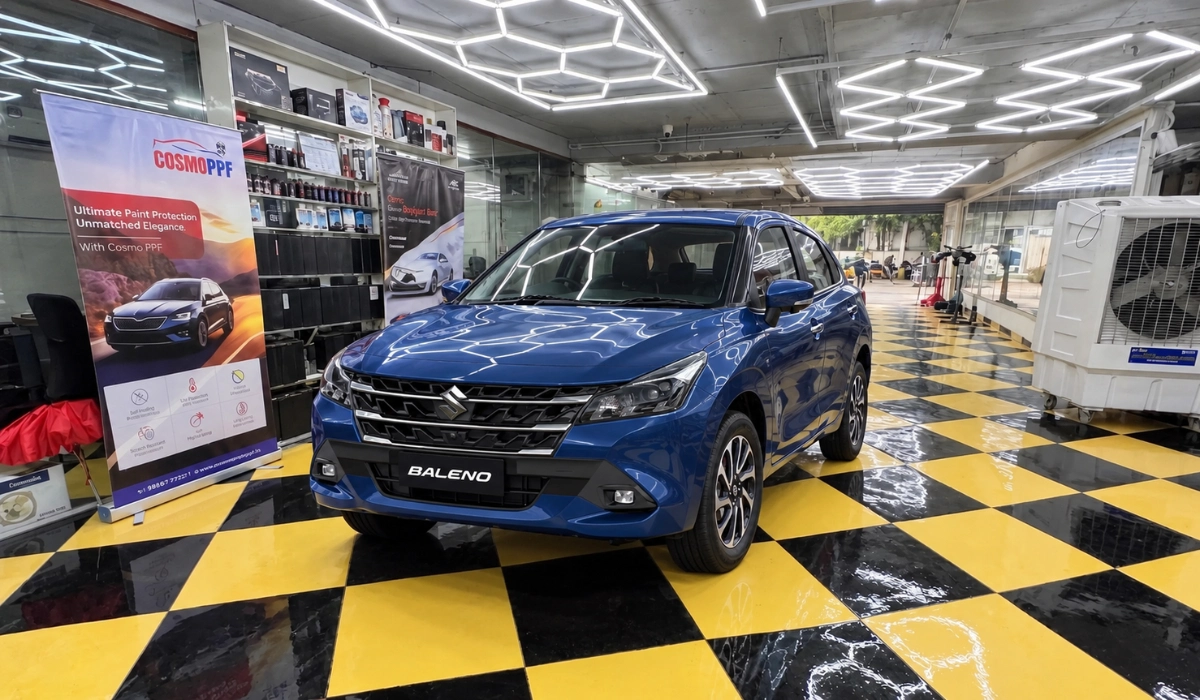
A new Enigmatic Teal colour expands the exterior colour choices. Inside, the overall dashboard design remains familiar. The car continues with a nine-inch touchscreen infotainment system and a semi-digital instrument cluster. However, Maruti Suzuki has added features such as ventilated front seats, tyre pressure monitoring, and Level 2 ADAS. The Baleno remains a five-seater hatchback with a 318-litre boot.
Maruti Suzuki Baleno Engine and Performance
The 2026 Baleno gets a new 1.2-litre Z Series three-cylinder petrol engine. The engine has a displacement of 1197 cc and produces 82 bhp at 5700 rpm. Maximum torque stands at 112.4 Nm at 4500 rpm. According to the specifications provided, the engine is paired with a five-speed manual gearbox and sends power to the front wheels through a FWD drivetrain.
Maruti Baleno engine specifications
| Specification | Details |
| Engine | 1.2L Z12E |
| Displacement | 1197 cc |
| Cylinders | 3 |
| Maximum Power | 82 bhp at 5700 rpm |
| Maximum Torque | 112.4 Nm at 4500 rpm |
| Gearbox | 5-speed manual |
| Drive Type | FWD |
| Fuel Type | Petrol |
| Fuel Tank | 37 Litres |
| Seating Capacity | 5 |
The three-cylinder engine is designed around everyday usability and efficiency rather than outright performance. For city driving, the compact dimensions and Front Wheel Drive layout make the Baleno easy to manoeuvre.
Maruti Baleno Mileage
Mileage remains one of the biggest reasons buyers consider the Baleno. The supplied specifications list an ARAI mileage of 23.8 kmpl for the petrol version. The broader Baleno information also lists mileage figures ranging from 23.8 to 24.77 kmpl, depending on the variant and fuel configuration.
Actual mileage will naturally depend on several factors. Traffic conditions, driving style, tyre pressure, air conditioner usage, road conditions, and vehicle load can all affect fuel consumption. A new owner should therefore treat the ARAI figure as a standardised testing figure rather than a guaranteed real-world mileage figure.
For better fuel economy, avoid unnecessary hard acceleration, maintain correct tyre pressure and follow the recommended service schedule.
Maruti Suzuki Baleno Dimensions and Boot Space
The Baleno continues to have dimensions that work well for Indian roads. It measures 3990 mm in length, 1745 mm in width and 1530 mm in height. The wheelbase measures 2520 mm. The car offers 318 litres of boot space, useful for daily shopping, office use, and weekend trips.
Baleno dimensions
| Specification | Measurement |
| Length | 3990 mm |
| Width | 1745 mm |
| Height | 1530 mm |
| Wheelbase | 2520 mm |
| Boot Space | 318 litres |
| Seating | 5 seats |
| Fuel Tank | 37 litres |
The relatively compact length also makes the Baleno practical in crowded urban areas. At the same time, the wheelbase helps provide a comfortable amount of cabin space for passengers.
Maruti Baleno Features
The facelift retains several familiar features while adding new equipment. The car gets a nine-inch touchscreen infotainment system with Apple CarPlay and Android Auto. It also offers wireless phone charging, a multi-speaker audio system, USB connectivity, and voice commands.
Other notable convenience features include automatic climate control, a height-adjustable driver seat, power windows, keyless entry, engine start/stop button, rear parking sensors, and a 360-degree camera. The car also gets a heads-up display, which helps the driver view important information without constantly looking down at the instrument cluster.
The car also gets a heads-up display, which helps the driver view important information without constantly looking down at the instrument cluster. One of the more useful additions for everyday comfort is the ventilated front seats.
Maruti Baleno Safety Features
Safety is one of the biggest changes in the facelift. The 2026 Baleno gets a Level 2 ADAS system, which brings several driver assistance functions to the premium hatchback.
The listed ADAS features include forward collision warning, automatic emergency braking, lane departure warning, lane keep assist, lane departure prevention assist, and adaptive high beam assist.
The safety package also includes six airbags, ABS, brake assist, EBD, electronic stability control, traction control, ISOFIX child seat mounts, parking sensors and a tyre pressure monitoring system.
A 360-degree camera provides additional assistance when parking in tight spaces. For a new car owner, these features are useful, but electronic safety systems should support attentive driving rather than replace it. The driver should always remain responsible for controlling the vehicle.
Does Maruti Baleno Have Cruise Control?
The specifications provided for this Baleno list no cruise control. This is worth checking against the exact variant before making a purchase because equipment can differ between variants and markets. Buyers should always confirm the final feature list with the authorised dealer before booking the car.
Maruti Baleno Exterior Design
The facelift does not radically change the Baleno's silhouette. Instead, Maruti Suzuki has concentrated on the front end. The updated headlights, DRLs, larger grille and redesigned bumper give the car a fresher appearance. The 16-inch alloy wheels also receive a slightly revised design in the facelift information provided. A shark fin antenna is another exterior addition.
The rear design remains relatively familiar, which means existing Baleno owners may not notice a major difference from the side or rear. For new owners, keeping this exterior looking fresh becomes important because darker colours and glossy paint can show swirl marks, scratches, water spots, and road grime more easily. That is where professional paint protection can become useful.
Should You Get PPF for a New Maruti Baleno?
If you have purchased a new Baleno and want to keep the factory paint in good condition, PPF for Baleno is worth considering. Paint Protection Film, commonly called PPF, is a transparent protective film installed over painted body panels. It creates a physical layer between the original paint and everyday road hazards.
The front bumper, bonnet, fenders, ORVMs, and other high-impact areas are particularly exposed to stone chips, insects, road debris, and minor scratches. A good-quality PPF can help reduce the risk of damage to these areas.

For a new Baleno, PPF makes the most sense when your priority is physical protection. It is especially useful for owners who drive frequently on highways or want to preserve the original paint for the long term.
The Detailing Gang provides professional car PPF installation using branded paint protection products. For a new Baleno, the right coverage should be decided according to your driving conditions, parking environment, and budget rather than simply choosing the cheapest package.
Paint Protection Film price in Delhi, India for Maruti Suzuki Baleno Facelift starts from Rs 43,000 and goes up to Rs 1,60,000+.
Read More:
Is Ceramic Coating Good for Maruti Baleno?
Ceramic coating for Baleno serves a different purpose from PPF. A ceramic coating forms a protective layer over the paint. It does not provide the same physical impact protection as PPF, but it can make the surface more resistant to contaminants and easier to maintain.
One of its most noticeable benefits is water behaviour. A quality ceramic coating creates a hydrophobic surface, which causes water to bead and roll off more easily. This can be particularly helpful during India's monsoon season.
Ceramic coating can also improve the gloss and depth of a properly prepared paint surface. However, coating should not be treated as a solution for every type of paint damage. It will not make the car completely scratch-proof or prevent stone chips in the way a proper PPF can.
Ceramic Coating price in Delhi, India for Maruti Suzuki Baleno Facelift starts from Rs 10,000 and goes up to Rs 50,000+.
PPF vs Ceramic Coating for Baleno
The simplest way to understand the difference is this:
- PPF protects the paint from physical damage.
- Ceramic coating protects the surface and makes maintenance easier.
If your main concern is stone chips and minor physical damage, PPF is the more suitable choice.
If your priority is gloss, easier cleaning, and protection against environmental contaminants, ceramic coating can be a better fit.
Some Baleno owners may also choose both. PPF can protect vulnerable areas while ceramic coating can be applied to suitable exposed surfaces, depending on the product and installation process. The important part is proper paint preparation and professional installation.
How to Maintain a New Baleno After PPF or Ceramic Coating
Paint protection only works well when you maintain the vehicle properly. Avoid automatic car washes that use aggressive brushes. Hand washing with a quality pH-neutral car shampoo is a safer approach. Use clean microfiber towels and avoid wiping a dusty car because dry wiping can create unnecessary marks.
After washing, dry the vehicle properly rather than allowing mineral-rich water to evaporate naturally on the paint. If you install PPF or ceramic coating, ask the installer about the recommended curing period and maintenance products.
Different products have different requirements, so following the manufacturer's instructions is important. Regular maintenance also helps you get better long-term value from the protection treatment.
Maruti Baleno Price and Ownership
The supplied 2026 Baleno information lists a starting ex-showroom price of Rs. 6.10 lakh. The provided Delhi on-road figure for the base Sigma variant is around Rs. 6.99 lakh.The supplied variant information also lists Delta, Zeta, Alpha O, and Alpha versions, with different price ranges. Because variant availability and pricing can change, buyers should confirm the latest ex-showroom price, registration cost, insurance, and final on-road price before booking.
For most buyers, the total ownership cost matters more than the headline showroom price. Fuel economy, insurance, service, tyres, and regular maintenance should all be considered when calculating the long-term cost.
Final Verdict
The Maruti Suzuki Baleno 2026 continues to be a practical premium hatchback for buyers who want a comfortable five-seater with good efficiency and manageable dimensions. Its new 1197 cc three-cylinder petrol engine produces 82 bhp and 112.4 Nm, while the claimed petrol mileage reaches 23.8 kmpl in the supplied specifications. The car also offers a 318-litre boot, a 37-litre fuel tank and FWD drivetrain.
The biggest technology upgrade is the addition of Level 2 ADAS, supported by six airbags and several active and passive safety features. Ventilated front seats, a nine-inch touchscreen, HUD, and a 360-degree camera add further convenience. For a new Baleno owner, protecting the exterior is also worth considering. PPF makes sense when physical paint protection is the priority, while ceramic coating is more suitable for improving surface protection, gloss, and ease of maintenance.
If you have just bought a new Baleno, The Detailing Gang can help you choose between PPF, ceramic coating, or a combination based on how and where you use your car. The goal should not simply be to add a treatment. It should be to choose the right level of protection for your driving habits and keep the original Baleno paint looking good for years.
 Recent Posts