How to Remove Swirl Marks Without Damaging Car Paint Safely
✏ A D Nath | 🔖 Car Care
Swirl marks are one of the most common paint problems car owners notice after washing or detailing their vehicles. They appear as fine circular or spiderweb-like scratches that become especially visible under sunlight, LED lights, or other strong lighting.
The good news is that most light swirl marks on car paint can be reduced or removed. The important part is choosing the right method. Using too much pressure, an aggressive compound, or the wrong polishing technique can remove more clear coat than necessary and create new paint defects.
If you want to know how to remove swirl marks without damaging car paint, the safest approach is to first understand the condition of the paint, prepare the surface properly, and always start with the least aggressive correction method.
What Are Swirl Marks on Car Paint?
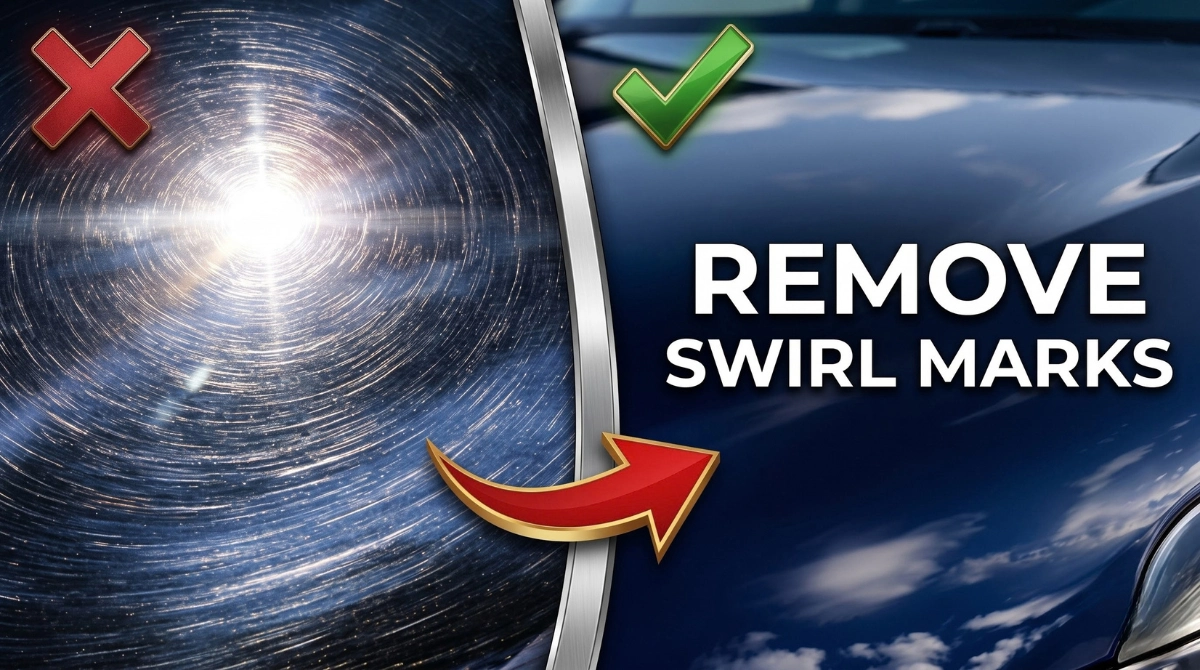
Swirl marks are very fine scratches, usually found within the clear coat, that scatter reflected light. This makes the paint look dull instead of giving it a deep and clear reflection. Despite their name, swirl marks are not always perfect circles. They can appear as fine lines, spider web patterns, or random micro-scratches depending on how the paint was washed and dried.
They are especially easy to notice on black, dark blue, and other darker colours. Most swirl marks come from repeated contact between dirt and the paint. A dirty wash mitt, rough towel, automatic brush wash, or wiping dust from a dry surface can drag tiny particles across the clear coat.
What Causes Swirl Marks?
Understanding the cause matters because polishing won't solve the problem permanently if you keep the same washing habits.
Common causes include:
- Washing with a dirty or contaminated mitt
- Using poor-quality or dirty microfiber towels
- Dry wiping dust from the car
- Using automatic car washes with abrasive brushes
- Washing without properly rinsing the wash mitt
- Applying too much pressure while washing
- Drying by aggressively rubbing the surface
- Using one bucket for the entire wash process
A proper pre-wash and careful contact wash can significantly reduce the amount of dirt that gets dragged across the paint. A two-bucket washing method, a clean microfiber wash mitt, and a suitable drying towel are commonly recommended for safer maintenance.
Can Swirl Marks Be Removed Without Damaging Paint?
Yes, but the method matters. The clear coat provides protection over the colour layer of your car. Paint polishing removes a very small amount of material from the surface, so the objective should always be to remove only what is necessary.
Professional paint correction works by carefully levelling the clear coat around a scratch so the defect becomes less visible or disappears. Unlike a wax or filler, polishing can actually correct suitable defects instead of simply hiding them.
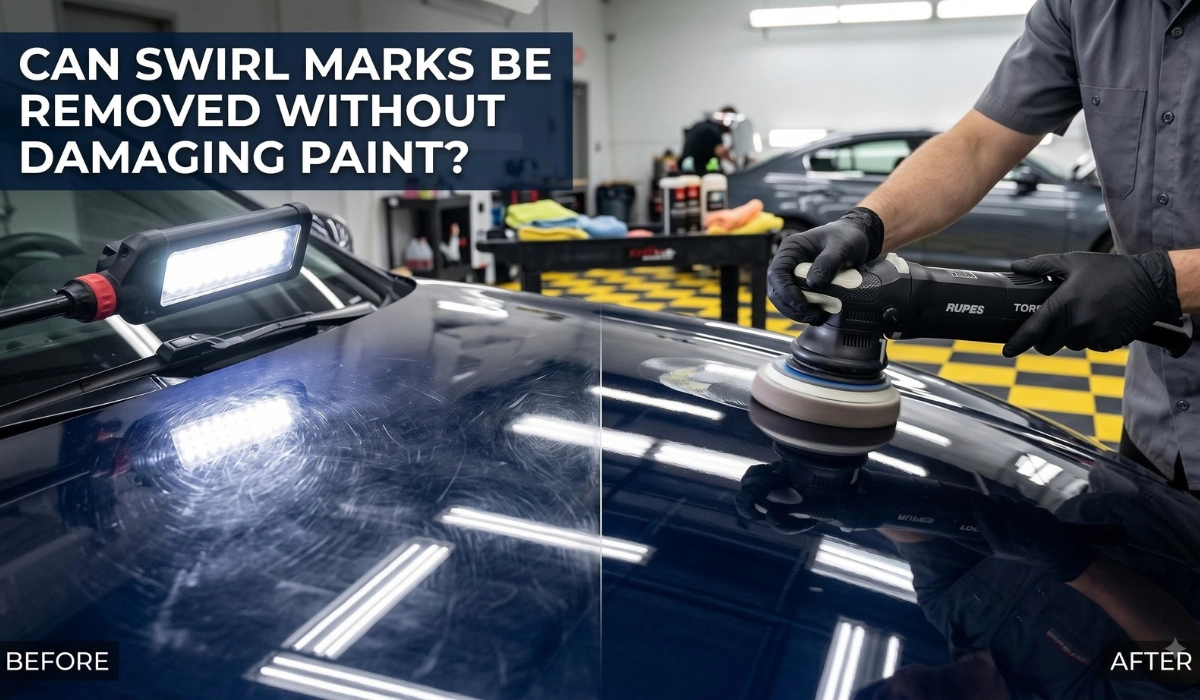
This is why aggressive polishing should not be the first step. Start with the mildest combination of polish and pad that can produce the required result. If the test area does not improve enough, you can gradually move to a stronger combination.
Step 1: Inspect the Paint Before Polishing
- Do not immediately reach for a compound when you see swirl marks.
- First, wash the vehicle and inspect the paint under strong, angled lighting. A clean surface makes it easier to understand how severe the marks actually are.
- Look at the panel from different angles. Some marks may be very shallow and visible only under direct light, while deeper scratches can remain visible from several angles.
- You should also check whether the scratch catches your fingernail. If it does, the damage may be more serious than a normal clear coat defect. Polishing may reduce its appearance, but trying to completely remove a deep scratch can require removing too much surrounding clear coat. This is where professional inspection becomes important.
Step 2: Wash the Car Properly
- Never polish a dirty car.
- Loose dust, sand, and road grime can become trapped between the polishing pad and the paint. Instead of removing existing defects, you could create additional scratches.
- Start with a thorough rinse or pre-wash. Then use a quality car shampoo and a clean microfiber wash mitt.
- The two-bucket method is useful because one bucket can hold your shampoo solution while the other is used to rinse the wash mitt. A grit guard can also help keep heavier particles away from the mitt.
- Wash from the cleaner upper sections towards the dirtier lower sections. Avoid putting unnecessary pressure on the paint.
- After washing, rinse the vehicle thoroughly.
Service: Car Washing Services
Step 3: Decontaminate the Paint When Necessary
- A clean-looking car can still have bonded contamination on the surface.
- If the paint feels rough after washing, the surface may need further decontamination. Depending on the type of contamination, this can involve suitable chemical decontamination or a clay bar treatment.
- The purpose is simple. You want the polishing pad to work against the paint rather than dragging contamination across it.
- 3D Products India also recommends cleaning and decontaminating the surface before polishing, followed by a small test area before correcting the rest of the vehicle.
Step 4: Always Perform a Test Spot
- This is one of the most important steps in safe swirl mark removal.
- Choose a small section of one panel and test your selected polish and pad combination.
- Start with a finishing polish or another mild correction method. Inspect the result under proper lighting.
- If the swirls have improved sufficiently, there is no reason to use a more aggressive compound.
- If the result is not strong enough, increase the cutting ability gradually.
- This approach reduces unnecessary clear coat removal and gives you a better understanding of how the particular paint responds to your chosen products.
Step 5: Choose the Right Polishing Method
- For very light swirl marks, hand polishing may provide some improvement. However, hand polishing can be inconsistent over large panels and may require considerable effort.
- For more noticeable defects, a dual-action polisher is commonly used by detailers because it provides controlled movement across the paint.
- The pad and polish combination should match the condition of the paint. A softer finishing pad with a mild polish may be enough for light defects. More serious defects may require a cutting pad and compound followed by a finishing polish.
- Do not assume that the strongest compound will produce the best result.
- The goal of paint correction is not to remove the maximum amount of clear coat. The goal is to achieve the required improvement while preserving as much original paint as possible.
Step 6: Use Controlled Polishing Technique
- If you are using a machine polisher, work on a small section at a time.
- Spread the product evenly and use controlled overlapping passes. Keep the pad moving rather than concentrating on one point for too long.
- Pay extra attention around body edges, sharp contours, and previously repaired panels.
- Clean the polishing pad regularly. A contaminated pad can affect the correction process and may introduce fresh marring.
- After completing a test section, wipe the panel carefully with a clean microfiber towel and inspect the result under suitable lighting.
Step 7: Know When to Stop
- One of the biggest mistakes in car paint correction is trying to make every scratch disappear.
- Some scratches are simply too deep to remove safely through polishing.
- If a scratch reaches beyond the clear coat, polishing cannot restore the missing paint. Continuing to compound the area will only remove more surrounding material.
- Professional detailers use paint inspection techniques and, where appropriate, paint thickness measurements to help determine how much correction is reasonable. The Detailing Mafia describes paint thickness measurement, controlled machine polishing, and inspection as part of its paint correction process.
- If you are unsure about the paint condition, stop rather than experimenting with increasingly aggressive compounds.
Does Wax Remove Swirl Marks?
Wax does not normally remove the underlying scratches. Some waxes, glazes, and products containing fillers can temporarily make light swirl marks less visible by improving gloss and filling minor surface imperfections.
That can make the paint look better, but it is different from actual swirl mark removal. True correction normally involves polishing the surface to reduce or remove the defect. Diamondbrite also distinguishes abrasive polishing from products that simply mask the appearance of swirls.
Should You Remove Swirl Marks Yourself?
DIY correction can work when the defects are light, and you understand the basics of safe washing and polishing.
However, professional help makes more sense when:
- The scratches are deep
- The vehicle has soft or sensitive paint
- The panel has previous paintwork
- The paint has severe oxidation or defects
- You do not have experience with machine polishing
- You are working on an expensive or difficult-to-correct vehicle
- You are unsure how much clear coat can safely be removed
A professional detailer can inspect the paint and select an appropriate correction process rather than using the same method on every vehicle.
How to Prevent Swirl Marks After Correction?
Removing swirls is only half the job. Poor washing can bring them back.
Use these simple habits:
- Rinse the vehicle before touching the paint
- Use a clean microfiber wash mitt
- Follow the two-bucket washing method
- Use a suitable car shampoo
- Wash from top to bottom
- Rinse the mitt regularly
- Never wipe dust from dry paint
- Use a clean microfiber drying towel
- Avoid automatic brush washes
- Do not scrub the paint aggressively
- Keep your wash and drying towels clean
Proper washing and drying techniques reduce the friction that creates new micro-scratches.
Does Ceramic Coating Prevent Swirl Marks?
A ceramic coating can make the surface easier to maintain and may provide some additional resistance to light washing-related marring, but it does not make the paint scratch-proof. If the car is washed incorrectly, dirt can still be dragged across the coated surface.
For this reason, ceramic coating and proper car washing should be viewed as part of a wider paint care routine rather than a replacement for careful maintenance.
If the paint already has visible swirl marks, correcting the surface before applying long-term protection can help improve the final appearance. The Detailing Mafia also recommends paint correction as a preparation step before protective treatments such as ceramic coating or PPF.
Final Thoughts
The safest way to remove swirl marks is to avoid unnecessary correction. Start by properly washing and decontaminating the paint. Inspect the surface under good lighting, perform a test spot, and begin with the least aggressive polishing combination that can deliver the result you need.
Remember that a clear coat is a limited protective layer. Removing more paint does not automatically mean getting better results. For light swirl marks, careful polishing may be enough. For deeper scratches, sensitive paint, or valuable vehicles, professional paint correction can reduce the risk of making the problem worse.
Most importantly, change the washing habits that caused the swirls in the first place. A careful wash routine, clean microfiber products and proper drying technique can help keep your corrected paint looking glossy for much longer.
Frequently Asked Questions About Swirl Marks
Q1. Is it possible to remove swirl marks from car paint?
Ans. Yes. Light to moderate swirl marks can often be reduced or removed from the clear coat through proper polishing or paint correction. The safest method depends on the depth of the marks and the condition of the paint. Deeper scratches may not be safe to remove completely because excessive polishing can reduce the clear coat.
Q2. Are swirl marks permanent damage?
Ans. Not necessarily. Most light swirl marks are surface-level defects in the clear coat and can often be corrected. However, deeper scratches that have gone through the clear coat cannot be completely removed through normal polishing. Trying to remove them completely may cause more damage to the surrounding paint.
Q3. Can swirl marks be buffed out?
Ans. Yes, many light swirl marks can be corrected through machine polishing or buffing with the right pad and polishing compound. The process should start with a mild combination and become more aggressive only when necessary. Using excessive pressure or an aggressive compound can remove more clear coat than needed.
Q4. How do I get rid of swirl marks without polishing?
Ans. You can make light swirl marks less noticeable with products such as glazes, fillers or some waxes, but these methods generally mask the defects rather than remove them. If you want actual correction, polishing is usually required because it levels the clear coat around the fine scratches.
Q5. Why do I still have swirls after buffing?
Ans. Swirl marks can remain after buffing if the polishing combination was too mild, the paint was not properly prepared, the pad became contaminated or the polishing technique was not suitable for the paint. Some marks may also be deeper than the correction process can safely remove. Inspecting the paint under proper lighting can help identify the reason.
Q6. How can I remove swirl marks from my car at home?
Ans. Start by thoroughly washing and drying the car without creating additional scratches. Inspect the paint, decontaminate it if necessary and perform a small test spot with a suitable polish and pad. Start with the least aggressive method and check the result before working on the entire vehicle. If you are inexperienced with machine polishing, professional paint correction can reduce the risk of damaging the clear coat.
Q7. Are swirl marks removable?
Ans. Many light swirl marks are removable or can be significantly reduced. The result depends on their depth, the condition of the clear coat, and the polishing method used. Very deep scratches may only be partially corrected because completely removing them could require excessive clear coat removal.
Q8. Why do cars get swirl marks?
Ans. Swirl marks usually develop when dirt or fine particles are dragged across the paint. Common causes include poor washing techniques, dirty wash mitts, contaminated towels, automatic brush washes, dry wiping, and aggressive drying. Using clean microfiber products and a careful wash process can help prevent them.
Q9. Will wax remove swirl marks?
Ans. Wax does not normally remove swirl marks. Some waxes and paint products can temporarily hide light defects or improve the appearance of the paint, but they do not actually correct the scratches. Permanent correction generally requires polishing or another appropriate paint correction process.
Q10. What is the safest way to remove swirl marks?
Ans. The safest approach is to inspect the paint first and use the least aggressive correction method that produces the desired result. Proper washing, decontamination, a test spot and controlled polishing can help reduce unnecessary clear coat removal.
Q11. Can a dual action polisher remove swirl marks?
Ans. Yes. A dual action polisher can be used to correct many types of light to moderate paint defects when combined with the appropriate pad and polish. It should still be used carefully, particularly around sharp edges, body lines and previously repaired panels.
Q12. Can hand polishing remove swirl marks?
Ans. Hand polishing can improve very light swirl marks, especially on small areas. However, achieving consistent correction across an entire vehicle by hand can be difficult and time-consuming. Machine polishing is generally more effective for larger areas when performed correctly.
Q13. Do swirl marks come back after paint correction?
Ans. They can come back if the same washing or drying habits that caused them continue. Using a clean wash mitt, proper car shampoo, safe drying towels and careful washing techniques can help maintain the corrected finish.
Q14. Can ceramic coating remove swirl marks?
Ans. No. Ceramic coating does not remove existing swirl marks. The paint should generally be corrected before applying a coating if you want to improve the finish. Once applied, a ceramic coating can make routine maintenance easier, but it does not make the paint scratch-proof.
Q15. Can PPF prevent swirl marks?
Ans. Paint protection film can protect the areas it covers from many forms of minor surface damage and washing-related marring. However, PPF itself can also develop surface marks depending on the film and how the vehicle is maintained. Proper washing remains important.
Q16. Should I polish my car every time I see swirl marks?
Ans. No. Repeated polishing removes some amount of clear coat, so it should not become a routine replacement for proper washing. If the swirl marks are minor, focus first on improving your washing and drying technique. Polish only when the paint actually needs correction.
Q17. How often should car paint be polished?
Ans. There is no fixed schedule for polishing. It depends on the condition of the paint, how the vehicle is washed and how much correction is required. Polishing should be based on the actual condition of the paint rather than performed simply because a certain amount of time has passed.
Q18. Can automatic car washes cause swirl marks?
Ans. Yes. Automatic washes that use brushes or other contact-based cleaning systems can contribute to fine scratches and swirl marks, particularly when dirt and debris remain on the cleaning equipment. A careful hand wash using clean microfiber equipment can reduce this risk.
Q19. Can microfiber towels cause swirl marks?
Ans. Yes, if they are dirty, contaminated, damaged or used incorrectly. A good microfiber towel can be safe for paint, but it still needs to be clean and suitable for the job. Never use a towel that has picked up sand, grit or other abrasive particles on delicate paint.
Q20. Are swirl marks more visible on black cars?
Ans. Yes. Swirl marks can appear on any colour, but they are usually easier to see on black and other dark paint because fine scratches create a stronger contrast against the reflective surface.
Q21. Should I remove swirl marks before ceramic coating?
Ans. Ideally, the paint should be inspected and corrected before applying ceramic coating if visible defects need to be addressed. A coating protects the condition of the surface you apply it to, so existing swirl marks will not disappear simply because a ceramic coating is installed.
 Recent Posts