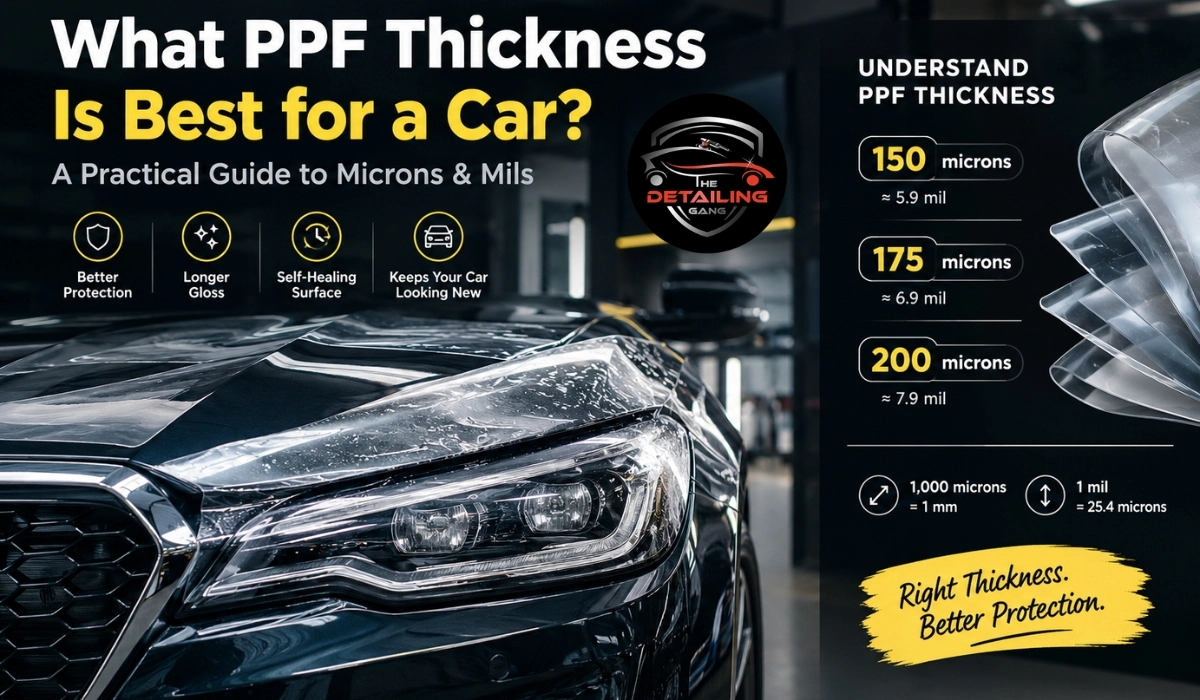
What PPF Thickness Is Best for a Car? Guide to Microns and Mils
✏ A D Nath | 🔖 Car Care
If you are planning to install Paint Protection Film (PPF) on your car, you have probably come across numbers such as 150 microns, 175 microns, 180 microns, or 200 microns. This often creates a simple question: Does thicker PPF mean better protection?
Not necessarily.
For most cars, the best PPF is not simply the thickest film available. The quality of the TPU, top coat, adhesive, optical clarity, self-healing performance, flexibility, and installation quality all matter. Thickness is important, but it is only one part of the complete PPF specification.
For Indian roads, a good-quality TPU PPF around the 150 to 200 micron range can provide excellent protection when it is properly manufactured and professionally installed. For many premium and luxury cars, around 175 microns offers a very practical balance between protection, flexibility, and finish.
Let's understand PPF thickness properly before you spend money on it.
What PPF Thickness Is Best for a Car?
For most cars, 175 microns is a strong practical choice if the film is made from good-quality TPU and has a reliable top coat and adhesive system. That does not mean 150 microns is poor or 200 microns is automatically better.
A 150-micron premium TPU film can perform better than a thicker film made from inferior material. Similarly, a 200-micron film does not automatically provide twice the protection of a 100-micron film. The better approach is to look at the complete film specification.
For a daily-driven car in India, we would generally look at:
- 150 microns: Good protection for normal daily use
- 175 microns: Excellent balance for most premium and luxury cars
- 180 to 200 microns: Useful where additional material thickness is desired
- 200+ microns: Not automatically better just because the number is higher
The important thing is to buy genuine, branded TPU PPF rather than selecting a film only because someone says it is the thickest.
PPF Thickness Explained: Microns, Mil and MM
PPF thickness is normally discussed in microns or mils.
A micron is extremely small.
The basic conversion is:
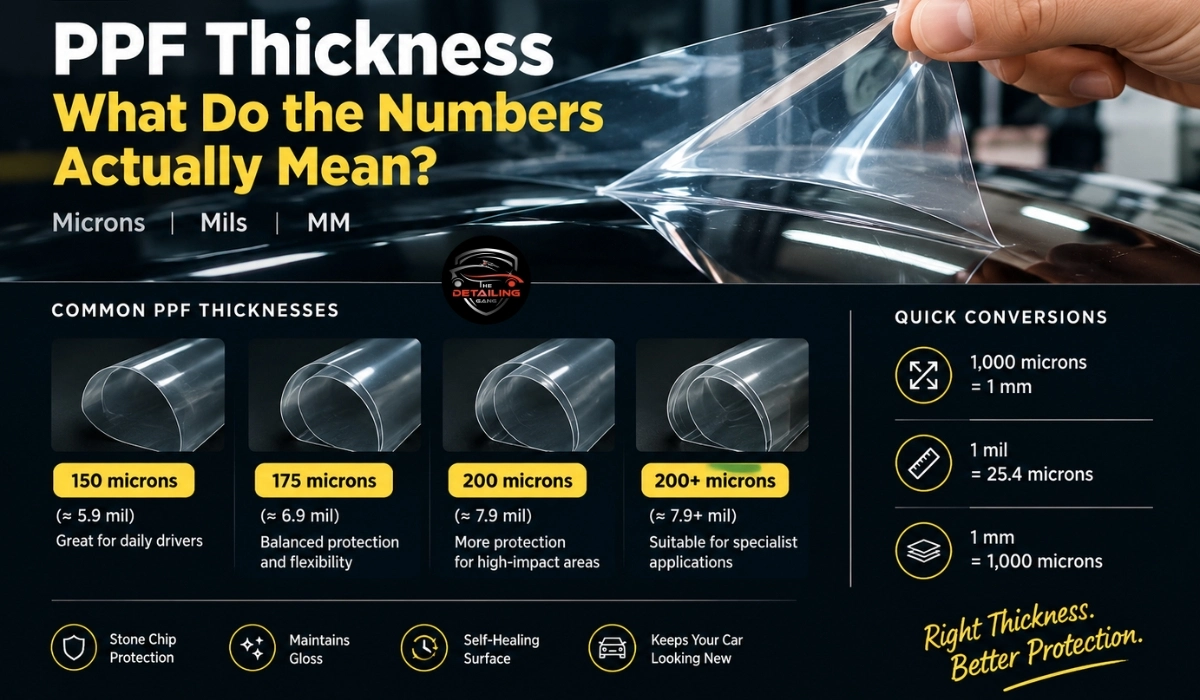
1,000 microns = 1 mm
In the PPF industry, you may also see thickness described in mils.
1 mil = 25.4 microns
So approximately:
| S.No | PPF Thickness | Approx. Mil |
| 1 | 150 microns | 5.9 mil |
| 2 | 175 microns | 6.9 mil |
| 3 | 180 microns | 7.1 mil |
| 4 | 200 microns | 7.9 mil |
This is why a PPF advertised as around 7 mil may be described as approximately 175 to 180 microns. Always check what the manufacturer is actually measuring. Some specifications can refer to the complete film construction rather than only the TPU layer.
How Thick Should PPF Be for an Indian Car?
Indian driving conditions make paint protection particularly useful. A car regularly faces stone chips, dust, road debris, insects, harsh washing, tight parking spaces, and occasional contact with bushes or other objects. Delhi NCR adds another challenge. A daily-driven car can quickly collect fine marks and contamination on the front bumper, bonnet and side mirrors.
This is where a good PPF makes sense.
For most Indian cars, 150 to 200 microns is a sensible thickness range. Around 175 microns is often a very good middle ground. But the right thickness also depends on how and where the car is driven.
A luxury sedan that mostly travels on city roads may not need the same specification as an SUV regularly driven on highways. Likewise, a weekend sports car may have completely different requirements from a daily commuter. The objective should be balanced protection, not simply maximum thickness.
Is Thicker PPF Always Better?
This is one of the biggest misconceptions when buying PPF. More material can provide advantages, but thickness alone does not determine performance. Think about it this way. A thicker film made from poor TPU is not automatically better than a slightly thinner film made from high-quality TPU.
The important factors include:
- TPU quality: The base material affects flexibility, durability, and resistance to yellowing.
- Top coat: A good top coat can improve stain resistance, gloss and self-healing performance.
- Adhesive: The adhesive needs to bond properly without creating unnecessary installation problems.
- Optical clarity: Premium PPF should protect the paint without making the car look hazy or distorted.
- Self-healing: A good self-healing layer can help reduce the appearance of light scratches and swirl-type marks caused by normal use.
- Installation: Even excellent PPF can look poor when installed badly.
So when someone tells you, This is the thickest PPF; therefore, it is the best, ask for the complete technical specification.
150 vs 175 vs 200 Micron PPF
Here is a simple comparison.
| Thickness | Best For | Protection Level | Main Advantage |
| 150 micron | Daily drivers | Good | Flexible and practical |
| 175 micron | Premium and luxury cars | Very Good | Strong balance of protection and finish |
| 180 micron | Premium applications | Very Good | Added material without excessive thickness |
| 200 micron | Higher protection requirements | Excellent | More material for demanding applications |
| 200+ micron | Specialist applications | Varies | Thickness alone should not determine the choice |
For most customers, 175 micron is a very sensible starting point. If the vehicle regularly travels on highways or the owner wants additional protection on high-impact areas, a thicker specification may be considered. But again, the film's actual construction matters more than a number printed on a brochure.
What Actually Makes a Good PPF?
When comparing PPF brands in India, do not stop at thickness.
Look at the complete package.
1. TPU Material
- TPU, or thermoplastic polyurethane, is widely preferred for quality paint protection film because of its flexibility and protective properties.
- A proper TPU PPF can conform to complex body panels while maintaining a clean appearance.
2. Top Coat
- The top coat is the surface layer that you see and touch.
- It plays an important role in gloss, stain resistance and self-healing performance.
3. Optical Clarity
- A clear PPF should remain visually clean after installation.
- On white, black and other glossy cars, clarity becomes particularly noticeable. Poor-quality film can affect the appearance of the paint.
4. Adhesive Quality
- The adhesive needs to provide reliable bonding while allowing professional installers enough working time to position the film correctly.
5. Warranty
- Do not look at warranty years alone.
- Understand what the warranty actually covers, such as yellowing, cracking, peeling or other film-related issues.
6. Installation Quality
- This is where the installer's skill becomes critical.
- Edges, corners, sensors, badges, curves, and difficult panels require proper preparation and application. A great PPF installed poorly can still produce disappointing results.
Best PPF Thickness for Different Cars
There is no single PPF thickness that is perfect for every vehicle.
Daily Driver
- For a normal city car, 150 to 175 microns can be a practical range.
- You may not need the thickest film if the vehicle mainly travels through urban roads and is driven carefully.
Premium Sedan
- For premium sedans and executive cars, around 175 microns can offer a strong combination of protection, appearance and flexibility.
Luxury Car
- For an expensive luxury vehicle, owners often prefer a premium TPU film around 175 to 200 microns, depending on the brand and application.
- The quality of the film becomes even more important because replacing or repainting expensive body panels is not something most owners want to deal with.
SUV
- SUVs often face more exposure to road debris, especially around the bonnet, bumper, fenders, and side mirrors.
- A 175 to 200 micron film can be considered depending on driving conditions and the areas being protected.
Bike
- The best PPF micron for a bike depends on the panel, shape and film construction.
- Motorcycles have smaller, curved and sometimes complicated surfaces. A flexible film with good conformability can be more important than simply selecting the thickest option.
Does PPF Thickness Affect Self-Healing?
Thickness and self-healing are related to the overall construction of the film, but thickness alone does not create self-healing. Self-healing generally comes from the film's top coat technology. Light surface marks can reduce or disappear when the film is exposed to suitable heat, depending on the product's design.
This is one reason why comparing only micron numbers can give you an incomplete picture. When comparing PPF, ask about self-healing technology, top-coat performance and warranty, not just thickness.
What PPF Thickness Should You Choose in Delhi NCR?
For a car regularly driven in Delhi NCR, we generally recommend quality TPU PPF in the 150 to 200 micron range, with around 175 microns as a strong practical option for many vehicles. But the recommendation should depend on the car and how you use it.
If you drive mostly in the city, 150 to 175 microns may be perfectly adequate. If you frequently travel on highways or want stronger protection for high-impact areas, 175 to 200 microns can make more sense.
At The Detailing Gang, we believe customers should know exactly what they are paying for. That means discussing the brand, film construction, thickness, warranty, and application instead of simply selling the highest number.
How to Check PPF Thickness Before Installation
Do not rely only on verbal claims.
Before installing PPF, ask the studio for:
- Manufacturer's technical specifications
- Actual thickness specification
- TPU construction details
- Warranty terms
- Product brand and model
- Top-coat information
- Self-healing details
- Installation coverage
- After-sales support
A genuine branded PPF should have proper product information available.
Also remember that the thickness of the installed film may include more than just the TPU layer. This is why comparing two products only by a single micron number can sometimes be misleading.
Which PPF Is Best for a Car in India?
The best PPF for a car in India is not necessarily the thickest PPF.
- A better choice is a genuine, high-quality TPU paint protection film from a reliable brand, installed by an experienced PPF team.
- Brands such as 3M, XPEL, LLumar, Saint-Gobain, Garware, and other established PPF manufacturers have different product specifications and price points.
The right choice depends on your car, budget, driving conditions, desired finish, and the level of protection you want. At TDG, we prefer to compare PPF based on its complete specifications rather than making the decision on thickness alone.

Final Verdict: What PPF Thickness Is Best?
So, what PPF thickness is best for a car?
- For most vehicles, 175 microns is an excellent practical choice when it comes from a quality TPU PPF and is professionally installed.
- A range of 150 to 200 microns can work very well depending on the vehicle and its usage.
But don't choose PPF simply because somebody claims it is the thickest. Look at the TPU quality, top coat, adhesive, clarity, self-healing performance, warranty, brand authenticity and installation quality.
The number matters.
The material behind that number matters more. And when the PPF is being installed on a car you have spent years saving for, that difference is worth understanding before you make the decision.
Frequently Asked Questions
Q1. Is thicker PPF better?
Ans. Not always. Thickness can contribute to protection, but TPU quality, top coat, adhesive, clarity, self-healing technology and installation quality are equally important.
Q2. What is the best PPF micron for a car?
Ans. For many cars, around 175 microns offers a strong balance between protection, flexibility and appearance. A 150 to 200 micron range can also be suitable depending on the vehicle and usage.
Q3. Is 200 micron PPF better than 175 micron?
Ans. Not automatically. A high-quality 175-micron PPF can be a better choice than a poor-quality 200-micron film. Compare the complete technical specifications rather than thickness alone.
Q4. What is PPF thickness in mm?
Ans. Since 1,000 microns equals 1 mm, 175 microns is approximately 0.175 mm, while 200 microns is approximately 0.2 mm.
Q5. What is 7 mil PPF in microns?
Ans. 7 mil is approximately 177.8 microns because 1 mil equals 25.4 microns.
Q6. What is the best PPF for a car in India?
Ans. The best PPF depends on the car, driving conditions, budget and desired protection. A genuine TPU PPF from an established brand with a good warranty and professional installation is generally a better choice than selecting a film only by thickness.
Q7. Does thicker PPF protect against stone chips better?
Ans. Thickness can help provide additional material for impact protection, but stone-chip resistance depends on the complete film construction. TPU quality, elasticity and film design are important factors too.
Q8. Is 150 micron PPF enough for a car?
Ans. Yes. A good-quality 150-micron TPU PPF can provide useful protection for many daily-driven cars. The correct choice depends on the vehicle and how it is used.
Q9. What PPF thickness is best for a bike?
Ans. Around 150 to 175 microns can be suitable for many motorcycle applications, but the film's flexibility and ability to conform to curved panels are particularly important.
Q10. Should I choose PPF based only on micron thickness?
Ans. No. Always compare thickness along with TPU quality, top coat, adhesive, optical clarity, self-healing performance, warranty, and installation quality.
 Recent Posts